


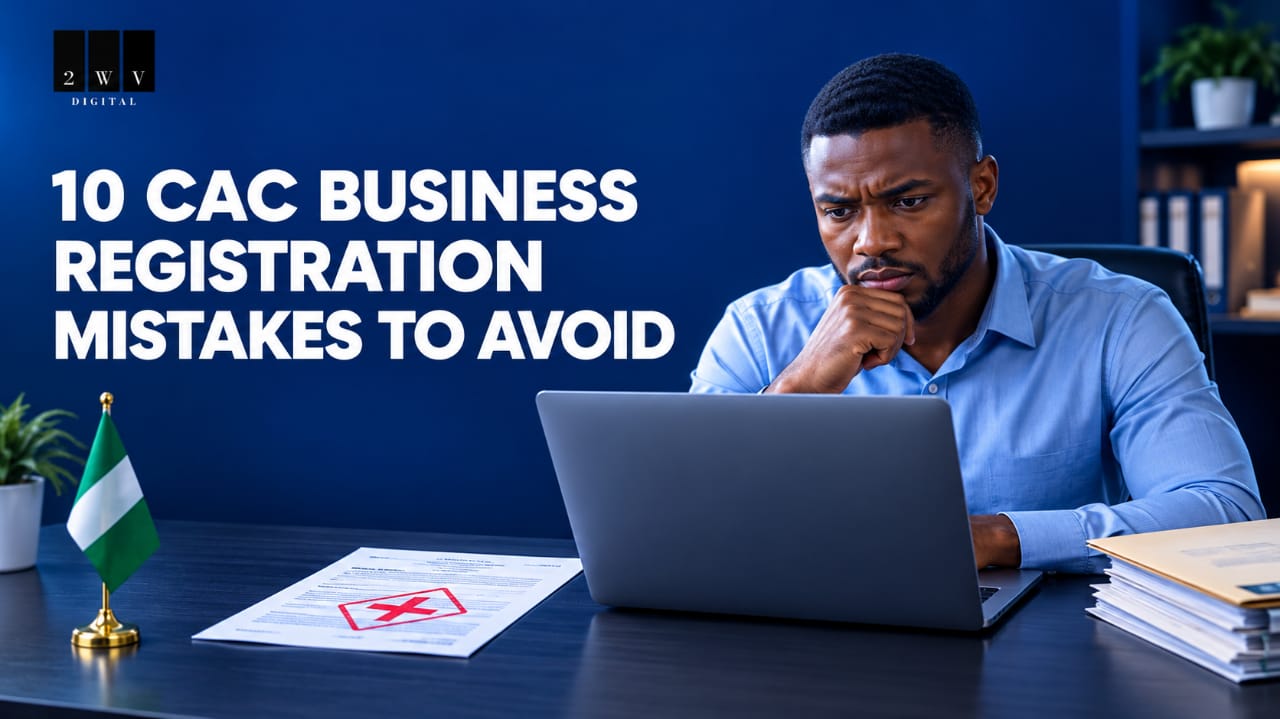
In July 2026, the Corporate Affairs Commission announced it was striking 100,000 companies off Nigeria’s business register for failing to meet statutory requirements. One hundred thousand businesses — many of them built by hardworking Nigerian entrepreneurs — wiped from the register because of mistakes that were entirely avoidable.
If you are about to register your business with CAC, or you already have and you are not sure you did everything correctly, this article is for you. These are the ten most common CAC registration mistakes Nigerians make — and what you should do instead.
Why CAC Registration Mistakes Are More Costly Than Ever in 2026
The CAC is not the same agency it was three years ago. The launch of the Intelligent Company Registration Portal (ICRP) in mid-2025, the mandatory NIN requirement for all registrations, rising filing fees, and an aggressive annual returns enforcement drive mean that errors you could once quietly ignore are now catching up with business owners fast.
Getting your registration right the first time has never mattered more.
Mistake #1 — Registering the Wrong Business Type
This is the most expensive mistake on this list because it is the hardest to undo.
Many Nigerian entrepreneurs register a Business Name when their business actually needs a Private Limited Company (LLC). The two are not interchangeable. A Business Name gives you no legal separation between yourself and the business — meaning your personal assets are on the line if anything goes wrong. An LLC is a separate legal entity that protects you.
The reverse also happens: someone registers an LLC with all the complexity that comes with it when a simple Business Name would have been perfectly sufficient for where they are right now.
Before you touch the CAC portal, decide which structure fits your actual business goals — not just what is cheapest or fastest.
The deeper breakdown of all four registration types, including a simple decision table, is in our eBook — Register Your Business With CAC in Nigeria: The Complete 2026 Guide.
Mistake #2 — Choosing a Business Name Without Checking Availability First
People spend weeks — sometimes months — building a brand around a business name before ever checking if it is available on the CAC portal. They design a logo, print packaging, set up Instagram, and then discover the name is already taken.
The CAC name search is free. It takes two minutes. Do it before you do anything else.
Also: do not submit just one name option. Prepare two to three alternatives in order of preference. If your first choice is rejected, having backups ready saves you days of delay and the frustration of starting the process over.
Mistake #3 — Submitting Expired or Blurry Documents
CAC officers review your uploaded documents manually. A blurry scan, a photo taken in poor lighting, or an ID that expired six months ago will get your application queried or rejected — and you will lose the time you spent waiting.
The rules are simple:
- Your government ID must be valid and clearly readable
- Your utility bill or bank statement must not be older than three months
- Your passport photograph must have a plain background — no busy walls, no shadows
- Every file should be under 2MB and in the correct format
Check every document before you upload. Not after.
Mistake #4 — Mismatched Information Across Documents
Your address on your utility bill must match the address you enter on the CAC form. Your name on your ID must match your name on every other document exactly. Even small discrepancies — a middle name missing here, an address written slightly differently there — trigger CAC queries that delay your application by days.
This sounds obvious. But it is one of the most frequent reasons applications are sent back.
Before submitting, lay all your documents side by side and cross-check the name and address on every single one.
Mistake #5 — Submitting a Poorly Drafted MEMART
This one is specifically for people registering a Private Limited Company.
The Memorandum and Articles of Association (MEMART) is your company’s founding document. It defines what your company exists to do, how it is governed, the rights of shareholders, and how major decisions are made. CAC reviews it carefully.
The most common MEMART mistakes:
- Downloading a generic template from Google and submitting it without review
- Object clauses that do not match the actual business activities described elsewhere in the application
- Missing or incorrectly drafted governance sections
- MEMART that does not comply with the requirements of CAMA 2020
A rejected MEMART means your entire application is sent back. You lose your waiting time and sometimes your filing fee. Get it reviewed by someone who knows what they are doing before you submit.
Mistake #6 — Paying CAC Fees Into a Personal Bank Account
This is not a mistake — it is a scam. And it costs Nigerians millions of naira every year.
The scenario goes like this: someone who calls themselves a CAC agent — found on WhatsApp, Instagram, or referred by a friend — tells you to transfer your registration fees to their personal account. They promise to handle everything. Weeks pass. No certificate. No response. Money gone.
All CAC government fees are paid exclusively through the official CAC portal at portalcac.gov.ng. The payment goes through Remita or a debit card. There is no scenario where a legitimate CAC transaction involves a personal bank account.
If someone asks you to transfer money to their GTBank, Access Bank, or any personal account for CAC registration, walk away.
Mistake #7 — Not Monitoring Your Application After Submission
Many people submit their application and assume it will process automatically. It will not always.
CAC sometimes sends queries requesting additional information or document corrections. If you do not see the query and respond promptly, your application sits idle — and in some cases, it expires entirely.
Check your email and your CAC portal dashboard at least once every day from the moment you submit until your certificate arrives. Set it as a daily reminder if you need to.
Mistake #8 — Ignoring CAC Queries
Related to the point above — but different. Some people see the query, feel overwhelmed by it, and put it aside to deal with later. Later becomes never.
A CAC query is not a rejection. It is a request for clarification or an additional document. Most queries can be resolved in under 24 hours if you respond quickly with the right information.
The moment you receive a query, open it, read it carefully, and respond the same day. Speed here directly determines how fast your certificate arrives.
Mistake #9 — Not Filing Annual Returns After Registration
This is the mistake that got 100,000 businesses struck off the register in July 2026.
Many Nigerian entrepreneurs register their business, receive their certificate, and never interact with CAC again. What they do not realise is that Private Limited Companies and Incorporated Trustees are legally required to file Annual Returns with CAC every year to keep their registration active and in good standing.
Missing Annual Returns results in:
- Penalty fees that compound every year
- Your company being marked as “inactive” on the CAC register
- Potential striking off — which means losing your registration entirely
- Banks and clients flagging your company as non-compliant during due diligence
Set a reminder. File your returns. It is not optional.
Business Name registrations do not file Annual Returns but must be renewed periodically — a detail many sole proprietors also miss.
Mistake #10 — Thinking Registration Ends at the Certificate
Getting your CAC certificate is the beginning, not the finish line.
After registration, there are several critical next steps that most business guides leave out — steps that determine whether your registration actually works for your business or just sits in a folder collecting dust.
We cover these post-registration steps in full detail in the eBook, but the short version is: your certificate alone does not open bank accounts, activate payment gateways, or make you tax-compliant. There is a sequence of actions to take immediately after receiving your certificate, and skipping them is its own category of costly mistake.
Final Word — Get It Right the First Time
CAC registration is not complicated when you know what you are doing. But the gaps in most people’s knowledge — wrong structure, bad documents, no MEMART review, paying the wrong person — turn a simple process into weeks of delays, lost money, and frustration.
If you want the complete, step-by-step guide to registering your Nigerian business with CAC — including the full document checklist, a breakdown of every fee, the MEMART explained in plain language, a scam-avoidance chapter, and exactly what to do after you get your certificate — our eBook covers it all.
👉 Register Your Business With CAC in Nigeria: The Complete 2026 Guide — Get the eBook on Selar
Walk away from this article knowing the mistakes. Walk away from the eBook knowing exactly how to avoid every single one of them.
Frequently Asked Questions
What are the most common reasons CAC rejects a business name in Nigeria?
The most common reasons are: the name is identical or too similar to an existing registered business, the name contains restricted words like “Federal,” “National,” or “Bank” without special approval, or the name is purely descriptive with no distinctive element. Always run a name availability search before paying for reservation.
Can I correct a mistake after CAC registration?
Yes — but it comes with a process and fees. Changes to company details, director information, registered address, or business activities must be formally filed with CAC as an alteration. The longer you leave an error uncorrected, the more it complicates future banking, contract, and compliance processes.
What happens if I don’t file Annual Returns with CAC in Nigeria?
Your company accumulates late filing penalties for every year missed. Beyond the financial cost, CAC can mark your company as dormant and ultimately strike it off the register entirely — as happened to 100,000 Nigerian companies in 2026. Reinstatement after striking off is possible but expensive and time-consuming.
Published by 2WV Digital — Digital Marketing & Business Growth Agency, Lagos, Nigeria.
Visit us at 2wvdigital.com.ng


